Skip to content
The interpretation gap Protocols About Methodology Request Access
CC68GLOBAL semantic architect
Amazon Semantic Architecture

Your listing exists.
The algorithm decides
if anyone sees it.

Most brands are spending more on PPC because their listing structure is invisible to Amazon's AI. The problem is not the product. It is the architecture the system cannot read.

Semantic DebtInvisibility TaxDouble PenaltyRP ScoreRufus · CosmoBackend Sovereignty
48h
Forensic diagnosis. Verified. Delivered.
3
Proprietary interpretation layers. One architect.
$0
Spent on ads before fixing the architecture
The algorithm is making
decisions about your listing
right now.

Most brands only discover this when PPC costs start climbing without explanation. By then, the algorithm has already decided where your listing belongs — and it is rarely where you think.

The problem is not the product. It is not the ads. It is the architecture the system cannot read. And it has been invisible since the listing went live.

Book a strategic call ↗
Response within 24 hours · No commitment required
The interpretation gap
Amazon listing diagnostic audit
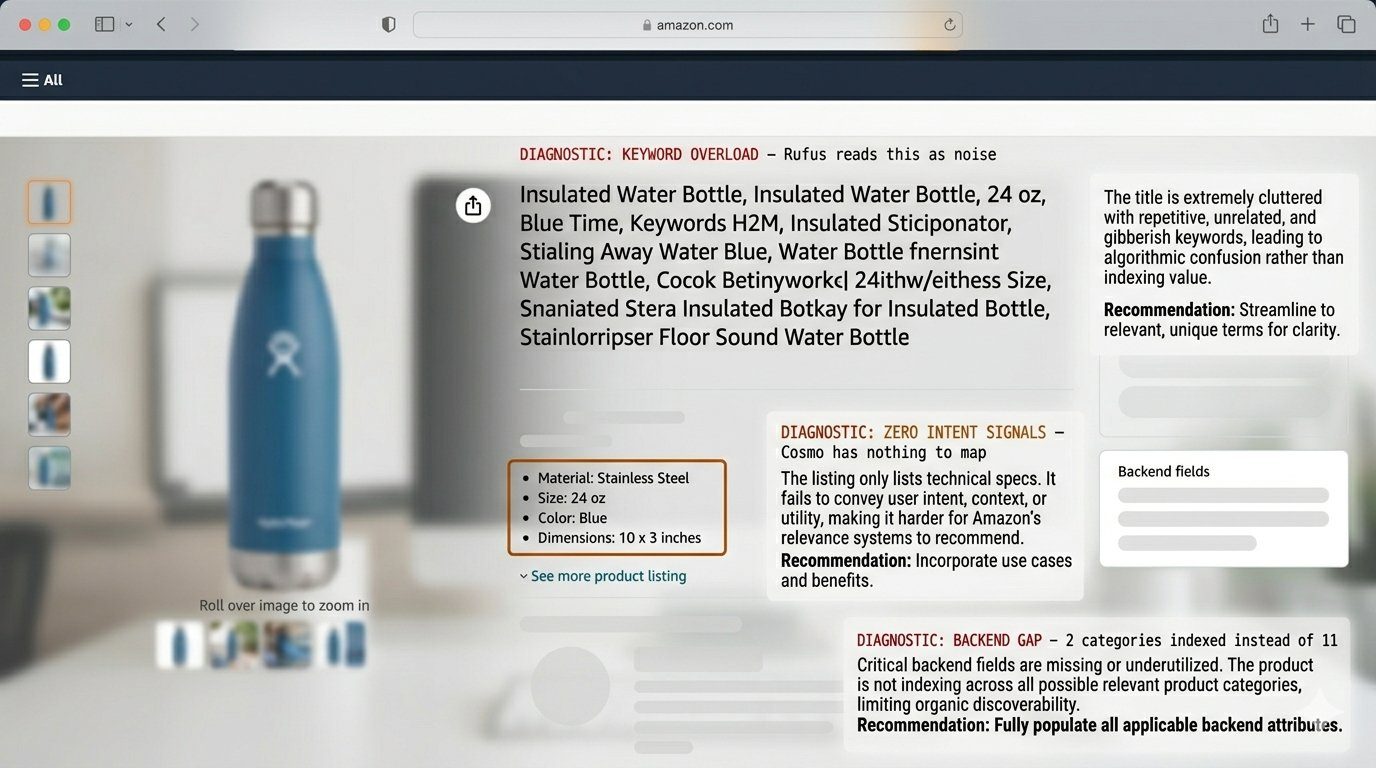
Live diagnostic — three structural failure points identified in under 8 minutes
Diagnostic finding

Two systems read
your listing.
Most sellers build for neither.

Rufus evaluates semantic relevance before any buyer sees your product. If the architecture is not built for both — you pay for every click the algorithm will not give you for free.

The listing above shows three structural failures visible in under 8 minutes. Keyword overload in the title. Zero intent signals in the bullets. Backend indexed in 2 categories instead of 11.

Good product. Real revenue. Invisible to the system that decides who sees it. That is not a copy problem. That is an architecture problem.

7 in 10 listings present critical semantic debt
CC68GLOBAL Pattern analysis 2026

7 in 10 listings we audit carry critical Semantic Debt — undetected.

Before a single buyer sees them. Before a single ad runs. The architecture is already broken.

The system has already decided where to place them. And it is not where the seller thinks.

Most listings do not fail because of the product. They fail because the system does not know where to put them.

01 — Title
Keyword stuffing reads as noise
Rufus interprets repetition as low relevance. A title with 12 keywords signals the listing does not know what it is.
02 — Bullets
Features without intent signals
Cosmo maps purchase intent, not product specs. Bullets that describe features give the system nothing to work with.
03 — Backend
Too clean or too chaotic
No semantic variation means the ranking engine indexes in 2 categories instead of 11. Both extremes are invisible.
04 — Architecture
Visual-semantic disconnect
$3,000 in photography. Zero semantic coherence. The system never shows the listing. The images never get seen.
Protocols

Precision protocols.
Not generic optimisation.

Each protocol is calibrated to a specific stage of the architectural failure — from rapid diagnosis to full semantic reconstruction. The difference between a listing that exists and one the system actively recommends is structural.

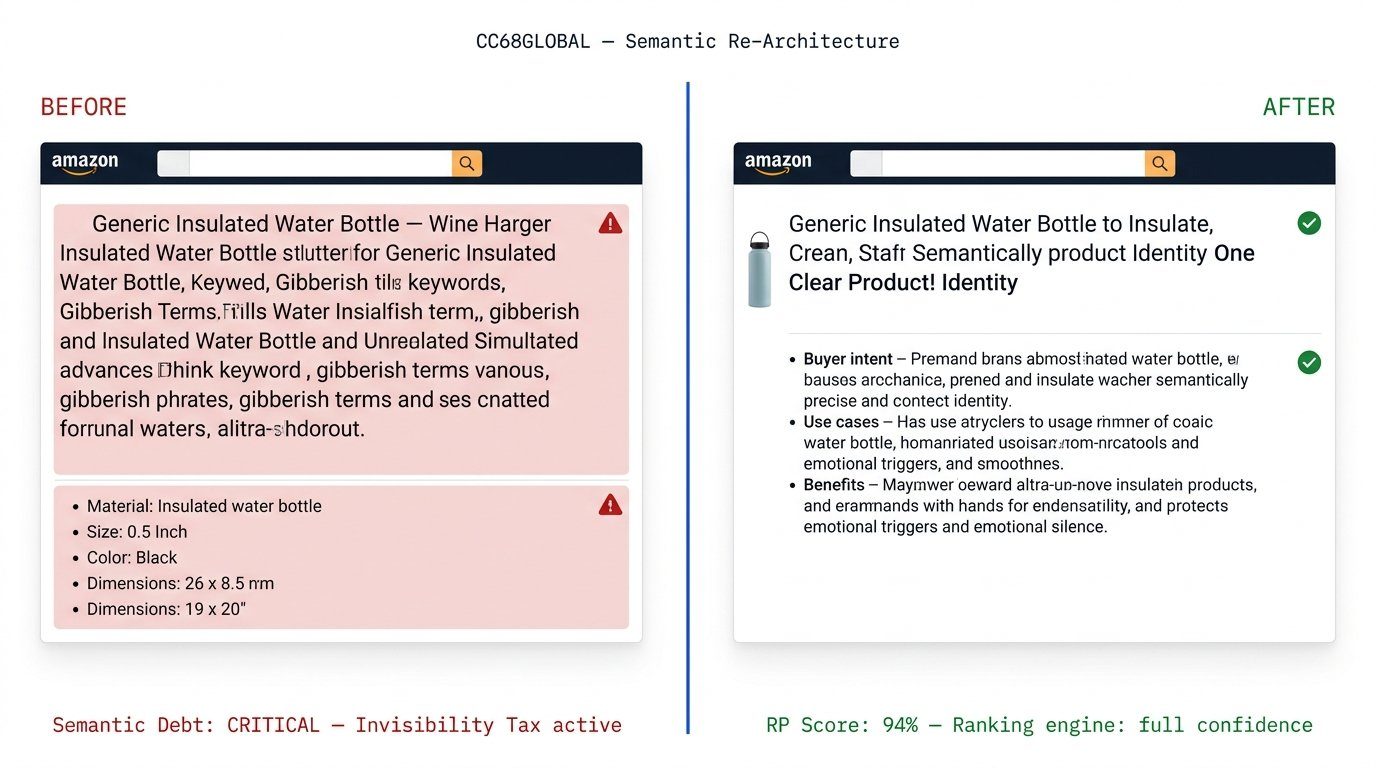
Before: Semantic Debt critical — Ambiguity Tax active
After: RP Score 94% — Ranking engine at full confidence

CC68GLOBAL Semantic Re-Architecture before and after
CC68GLOBAL Semantic Re-Architecture — same product, rebuilt architecture
02
Semantic Re-Architecture
Complete reconstruction. Every layer rebuilt for Rufus, Cosmo, and the ranking engine to read with full confidence.
Delivery: 7–10 days
Request a quote ↗
03
Deep Forensic Audit
Multi-listing analysis with competitive benchmarking, RP Score mapping and full intent framework audit across the catalogue.
Delivery: 5–6 days
Request a quote ↗
04
Listing Architecture from Zero
Full semantic architecture built from scratch for new products or relaunches. Title, bullets, backend and A+ structure designed from the first signal — so the system understands the listing before the first buyer sees it.
Delivery: 5–7 days
Request a quote ↗
07
Continuous Semantic Shielding
Monthly monitoring and architecture maintenance. Algorithm updates do not wait. Neither should your listings.
Ongoing — monthly delivery
Request a quote ↗
Shielding — Available as
Single ASIN
One core listing under continuous protection
Brand Pack
Up to 5 ASINs — multi-product operators
Full Catalogue
Unlimited ASINs + quarterly full architectural review
Pricing on request — based on catalogue size and complexity
Ready to rebuild
what the algorithm reads?
Book a call ↗
About
Carlos Caparros
Founder — CC68GLOBAL

My professional background is not in marketing. It is in precision technology.

For years I worked at the intersection of applied physics, optical engineering and medical technology — sectors where the margin for error is zero, where every process follows a protocol, and where results are always measurable. I trained directly with manufacturers, understood equipment at component level, and built the discipline of diagnosing before acting.

I managed sales teams, directed commercial operations across multiple markets, and led sourcing strategies with international partners. In every role, the same principle applied: you cannot optimise what you do not fully understand.

Ten years ago I made a deliberate decision to start from zero in eCommerce. Not as a side project — as a full commitment. I began by mastering high-performance media buying — learning how digital traffic works, how spend converts, and how platforms reward or punish the decisions sellers make. That foundation taught me something critical: the most expensive traffic in the world cannot save a listing the algorithm does not understand.

When I went deep into Amazon FBA and its AI ecosystem, I brought the same precision framework I had built over three decades. Not “how do I write a better listing” — but “how does the system actually read it, how does it decide where to place it, and what is making it invisible.”

Most people treat Amazon as a marketplace. I treat it as a technical system with its own physics — its own language, logic and failure modes. That is what CC68GLOBAL is built on.

I diagnose why listings with strong products and real revenue still lose visibility — and I rebuild the architecture that makes Amazon's AI understand what it is selling. The result is not better copy. It is a listing the system was built to recommend.

Background in applied physics, optical engineering and precision medical technology
30+ years in commercial leadership across technology, healthcare and international markets
10 years in eCommerce — high-performance media buying and Amazon FBA ecosystem
Founder CC68GLOBAL — Amazon Semantic Architecture specialist

Connect on LinkedIn ↗
Carlos Caparros — Founder CC68GLOBAL
Industry recognition
The CC68GLOBAL Standard

We do not work
with every listing.
Only the ones where
the problem is costing
serious money.

This is not a volume service. It is not an agency model. It is a specialist intervention — the kind that requires a human architect, a structured protocol, and the discipline to diagnose before acting.

Most brands that contact us already know something is wrong. They just do not know where.

01
Revenue threshold
Listings generating $20,000/month or more on a single ASIN. Below that level, the ROI of a full forensic intervention is difficult to justify for either party.
02
Operator profile
Sellers who already invest seriously in their Amazon presence — photography, PPC, logistics — and are experiencing invisible performance ceilings they cannot diagnose with standard tools.
03
Engagement model
We do not manage accounts. We diagnose structures, rebuild architectures, and protect them from algorithmic drift. The operator runs the business. We build what the machine reads.
Invisibility Signals

Three failure patterns.
Found in listings at every revenue level.

These are not hypothetical. They are structural patterns identified repeatedly across audited listings — in categories ranging from Home & Kitchen to Health & Personal Care, at revenue levels from $20K to $200K/month. The product is never the problem. The architecture is.

Signal 01
The Keyword Stuffing Paradox
Title architecture failure

The seller adds more keywords believing broader coverage means greater visibility. The outcome is the opposite. Rufus interprets high keyword density as a signal of low semantic coherence — the listing cannot identify what it is. Algorithmic confidence drops. The system deprioritises the listing in purchase-intent queries. The seller detects falling organic traffic and adds more keywords. The cycle compounds.

The invisible cost: The listing continues to appear in its primary keyword — so the seller sees no collapse. But it becomes progressively invisible in the high-intent, high-conversion queries where buyers actually decide.
Signal 02
The Clean Backend Illusion
Indexation architecture failure

The backend search terms are clean — no repetition, no irrelevant terms, no formatting errors. By every standard guide, it is correctly built. The problem is not what is there. It is what is missing. With 80 bytes of 250 available utilised, the ranking engine indexes the listing across 2 to 3 categories instead of 11 to 14. The seller never detects it because the listing ranks for its core keywords. The remaining 80% of applicable placement opportunities are simply never activated.

The invisible cost: Organic discoverability is structurally capped. No amount of PPC investment can reach the placements that a correctly architected backend would access for free.
Signal 03
The Intent Signal Void
Cosmo mapping failure

The bullet points are technically precise. Material, dimensions, certifications, compatibility. Everything accurate, everything verifiable. Cosmo reads the bullets looking for purchase intent signals — use cases, decision contexts, problems the product resolves. It finds none. Without intent architecture, the listing cannot be matched to the conversational queries Rufus evaluates in real time. The product exists in the catalogue. It does not exist in the recommendation layer.

The invisible cost: The listing is excluded from Rufus-driven recommendations — the fastest-growing discovery surface on Amazon — regardless of its review count, pricing, or PPC investment.
You have seen the pattern.
Is your listing one of the 7 in 10?
or book a call ↗
Methodology

A proprietary protocol.
Not a prompt. Not a tool.

Most sellers apply AI to their listings and expect results. We apply a structured protocol that interrogates data across multiple layers before a single word is written. The difference is architectural.

Layer 01 — Input
Signal extraction
Every data source is interrogated through adaptive prompts — not to generate content, but to extract the specific signals that Amazon's ranking systems evaluate. What matters is identified. Everything else is discarded.
Layer 02 — Processing
Intent architecture
Extracted signals are mapped against purchase intent frameworks and algorithmic confidence models. The result is a structural blueprint — what the buyer needs to feel, and what the system needs to read, to trigger recommendation.
Layer 03 — Output
Semantic encoding
The blueprint is translated into listing architecture that the ranking engine categorises with full confidence. Every element — title, bullets, backend, description — is precisely calibrated. Not optimised. Architected.
The protocol
Proprietary adaptive prompt sequences activate each layer in a specific order. The sequence is the system. It cannot be replicated by running a single AI tool — the intelligence is in how the layers interact.
The architect
Every layer is overseen by a human architect who designs the prompts, validates the outputs and ensures semantic coherence. The AI executes. The architect decides.
The result
A listing that Rufus reads as relevant, Cosmo maps with confidence, and the ranking engine categorises across the maximum number of applicable categories. Visibility by design. Not by chance.
The intelligence
Every 15 days we update the CC68GLOBAL framework with the latest Amazon algorithmic movements and newly registered AI patents. We do not react to market changes. We anticipate them.
Semantic Risk Assessment

Request Diagnostic Access.
Complimentary for selected operators.

Answer 10 questions about your listing architecture. Our system cross-references your responses against the CC68GLOBAL framework and generates a personalised risk report — reviewed and verified by our architect within 24 hours.

Designed for established Amazon operators investing seriously in their listings.

Step 1 of 4 — Listing Architecture
Title & Bullet Architecture
1. How many characters does your main title have?
2. Does your primary keyword appear more than twice in the title?
3. Your bullet points describe mainly…
4. Paste your listing title here (optional — significantly increases accuracy)
Backend & Indexation
5. How many bytes do you have in your backend search terms?
6. In how many categories does your listing appear organically?
7. Do you have A+ Content active on this listing?
Algorithmic Behaviour Signals
8. Has your ACoS increased in the last 3 months without changing your bids?
9. How long has this listing been active and how stable has it been?
10. What is the main category of your listing?
Paste your Amazon listing URL (increases diagnostic accuracy to 90%+)
Your diagnostic is ready

Based on your responses, our system has identified several risk signals in your listing architecture. Enter your details to receive your full Semantic Risk Report — reviewed and verified by our architect within 24 hours.

Your name
Your email
Your ASIN
Approximate monthly revenue from this listing

Your data is used solely to generate your diagnostic report. No spam. No commitment.

Semantic Risk Assessment — Initial Findings

Based on your responses. Full verified report arriving within 24 hours.

What happens next

Our architect will open your listing directly in Amazon, cross-reference your responses with live data, and send you a complete Semantic Risk Report with specific recommendations — within 24 hours.

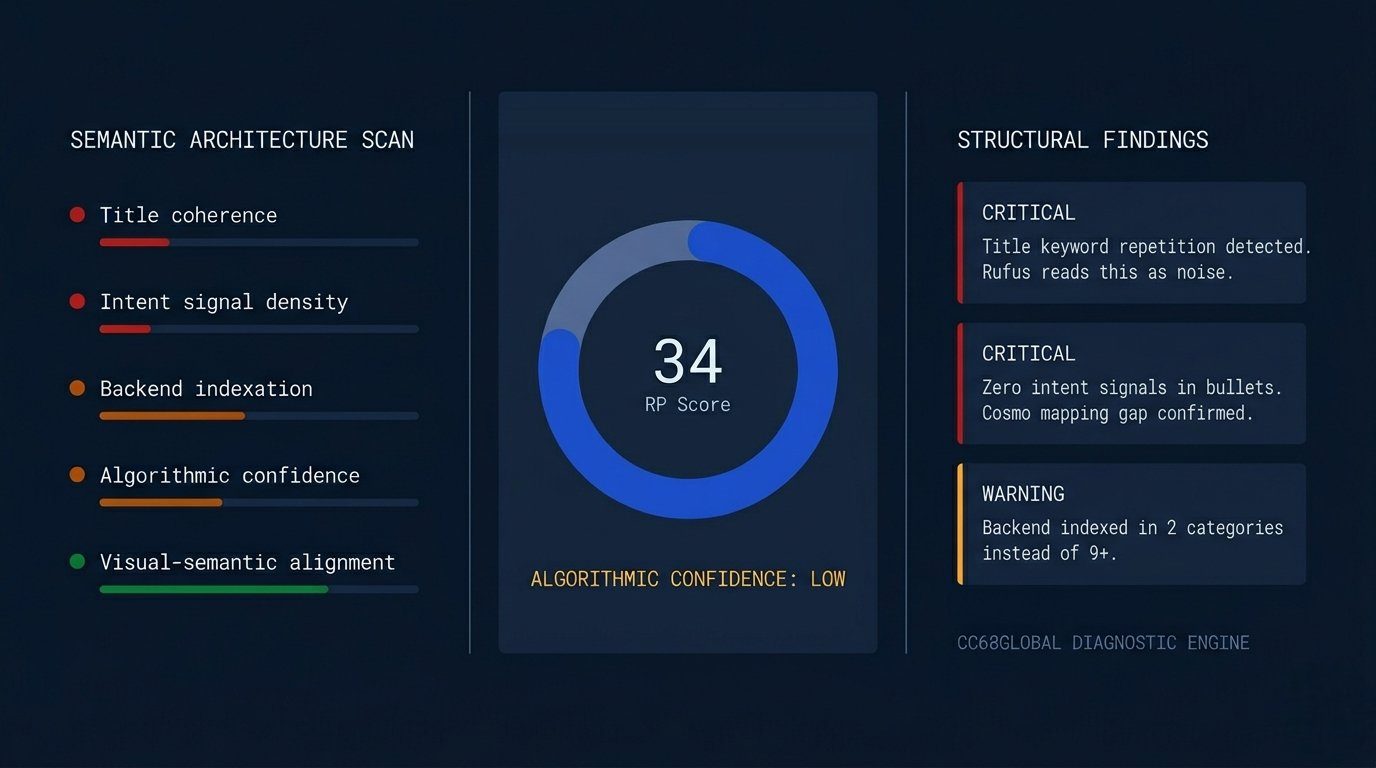
CC68GLOBAL Semantic Architecture Scan
Sample diagnostic output — CC68GLOBAL Engine
Your listing is speaking. The system is not listening.

The algorithm is making
decisions about your listing
right now.

Response within 24 hours · No commitment required